Tuesday, May 30, 2006

ApologetiX


I picked up a copy of an album by ApologetiX called Keep the Change, and I've had a blast listening to it.
ApologetiX writes parodies of classic and modern rock songs, turning them into Christian messages. For example, the Bee Gees' classic, "Stayin' Alive" becomes "Stay in the Light," and Bob Seger's "Old Time Rock and Roll" becomes "Old Time Romans Road." Eminem's "The Real Slim Shady" is transformed into "The Real Sin Savior."
As you can tell from these titles, they belt out an evangelistic Christian message. They challenge evolution in their remake of the theme from the "Monkees," which they call "Monkey Scheme." They talk about the Second Coming of Jesus in "Mama Told Me (What's to Come)," a parody of Three Dog Night's "Mama Told Me (Not to Come)." They encourage bold preaching in "Be Bold Jeremiah," a remake of Steve Miller Band's "Jet Airliner."
Probably their best song artistically is their version of Elton John's "Daniel," which they also title "Daniel," but the lyrics have the emperor who threw Daniel into the lions' den bemoaning his actions:
"Daniel's with lions tonight in a cave
I can see their red pale eyes testin' his faith
Oh, and I can see Daniel waitin' to die
God, it looks like Daniel-- won't be around in my life..."
The album has 19 songs, and they do a remarkable job at imitating the rock 'n' roll originals. As you can tell from the lines from "Daniel," their lyrics are extremely close to the original, yet with a radically different message. The quality of singing and musical instrumentation make the album both entertaining and throught-provoking.
The band says, "Of course, in ApologetiX, we change lyrics just as Christ changes lives. And we think both changes are worth keeping." I quite agree!

ApologetiX is made up of J. John Jackson, Karl Vaughn Messner, Keith "Stan" Haynie, and Bill "Veal" Rieger. You can learn more about them at www.apologetix.com.

Saturday, May 27, 2006

Memorial Day -- Let's remember


Last night I got a phone call from the local Vietnam Veterans organization, letting me know our daughter was awarded a Vietnam Veterans college scholarship. I called her cell phone, and she immediately called her grandfather, my Dad, who served as an Army chaplain in the Vietnam War.

That brought back a strong memory I had. I was in the 6th grade, living in Hattiesburg, Mississippi, while Dad was in Vietnam. Hattiesburg had suffered the effects of Hurricane Camille a few months before, and people certainly had a lot of things on their minds, but my Dad was always on my mind. He was stationed in Cu Chi, located between Saigon and the Cambodian border. The Vietcong were coming down the western side of Vietnam through Laos and Cambodia on the "Ho Chi Minh Trail" and then entering South Vietnam for their guerilla attacks. President Nixon decided to order American troops to invade Cambodia and put it to a stop. I remember watching with my Mom as the president explained all of this with a map on TV. As Nixon motioned where the invasion was, his hand went right over Cu Chi where my father was stationed. Mom explained that Dad was going in with the troops. As a chaplain, he would not be firing a gun, but he would be in the line of fire.
The next day, I took a map of Southeast Asia with me to school. Surely the other students had seen this on the news, and they knew my Dad was over there and would want to know about him. After all, we were not living on a military base, but in a civilian community, and I was the only kid in my class with a father in Vietnam. Surely they would gather around me, look at the map where my Dad was, and ask me questions about him.
However, I could not have been more wrong about my fellow students. I took the map, and tried to show it to students, but nobody was interested and nobody cared. I came home despondent. It was a very lonely year at that school.
But at least my Dad survived the war without injury and came home safe and sound. He even brought back trinkets captured from the Vietcong.

This Memorial Day, I think of those who served our country and never came home. Their sacrifice is much like the sacrifice of Jesus for our sins. No greater love is there than this-- to lay down one's life to give freedom to another. Thanks to our soldiers, we have freedom of worship in our country. Thanks to Jesus, we have freedom from sin.
Don't forget.
Here's a video that will help you remember.

Thursday, May 25, 2006

Intellectuals

Proud papa posts picture of darling daughters deep in thought, having graduated with "honors" and "cum laude."

Sunday, May 21, 2006

The Norman Rockwell Code

If you're bored with The Da Vinci Code, may I suggest The Norman Rockwell Code? Watch the movie trailer here.

Thursday, May 18, 2006

Da Vinci Disclaimer

Speaking on "The Today Show," actor Ian McKellen, who plays Teabing in the movie version of The Da Vinci Code, is asked if there should be a disclaimer at the beginning of the movie that it is fiction. The actor replies that he thinks the Bible should have a disclaimer that it is fiction.

Da Vinci Dull Movie

Variety magazine joins other critics in calling the movie version of The Da Vinci Code boring.
The conservative Christian journal World magazine reviews the movie and says that in addition to being boring, it tones down the anti-Christian rhetoric of the book.
Has anybody seen the movie yet? What did you think?

Saturday, May 06, 2006

Debunking Da Vinci Code # 6

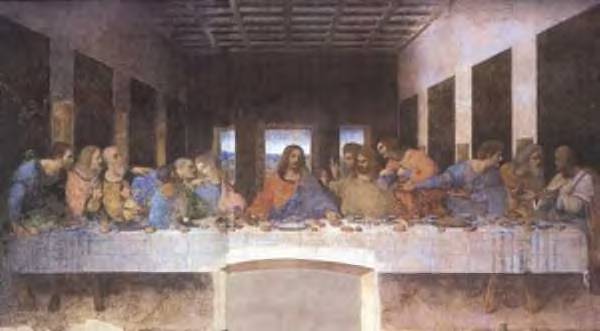
Dan Brown's novel, The Da Vinci Code, claims that Leonardo da Vinci painted Mary Magdalene at Jesus' right hand in The Last Supper, as a clue that she was really Jesus' wife.
Wouldn't it be nice if we could interview Leonardo and ask him who it was he was painting on Jesus' right hand? Well, actually, we can!
During the years 1494-1495, Leonardo drew sketches in preparation for his famous painting, and wrote notes labeling them. We have those sketches to read.
Here is what Leonardo wrote about the three characters to the right of Jesus: "Another speaks into his neighbour’s ear and he, as he listens to him, turns towards him to lend an ear, while he holds a knife in one hand, and in the other the loaf half cut through by the knife. Another who has turned, holding a knife in his hand, upsets with his hand a glass on the table."
Notice that all three of these persons are described with the masculine pronoun. Can there be any doubt that da Vinci intended to paint Peter (the one who "speaks into his neighbour's ear"), Judas (the one who "turned, holding a knife in his hand," and John (the one who as "he listens to him, turns towards him to lend an ear")? The editor of the sketches notes that when Leonardo actually did the painting, he had an upset "salt cellar" rather than a glass, but otherwise he painted it as described. No Mary Magdalene. No "V." No "M." No secret codes.
(Source: Jean Paul Richter, The Notebooks of Leonardo da Vinci, 1880. On the Internet at http://www.fromoldbooks.org/Richter-NotebooksOfLeonardo/. Note the "contents" to the right and click on "X. Studies and Sketches..." Then click on each of the four pages that give da Vinci's words and the editor's comments of the sketches.)

Friday, May 05, 2006

Debunking Da Vinci Code # 5

Dan Brown's novel, The Da Vinci Code, claims that Leonardo da Vinci painted Mary Magdalene next to Jesus Christ in his famous painting, The Last Supper, in order to leave a clue that Mary Magdalene was really Jesus' wife.
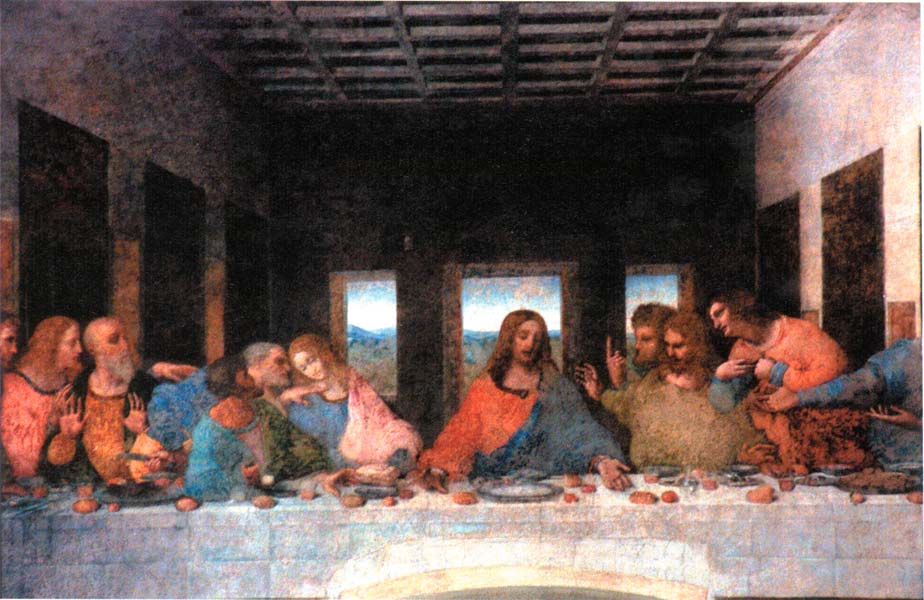
At first glance, it's an interesting idea, especially since the person on Jesus' right hand does look effeminate. However, the theory does not hold up under closer examination. Take a look at the painting:
To begin with, there are 12 people in the painting other than Jesus. Count them! They are in four groups of three each; six men on each side of Jesus. So if one of them was Mary Magdalene, then one of the 12 disciples is missing! Da Vinci often painted young men to look effeminate. In his early sketches, da Vinci said the disciple next to Jesus was John. This fits with the purpose of the painting, which was to visually depict the scene described in the New Testament gospels, when Jesus announced that he was being betrayed.
Read this passage from John 13:21-25 (Holman Christian Standard Bible):
When Jesus had said this, He was troubled in His spirit and testified, "I assure you: One of you will betray Me!"
The disciples started looking at one another-- uncertain which one He was speaking about. One of his disciples, the one Jesus loved, was reclining close beside Jesus. Simon Peter motioned to him to find out who it was He was talking about. So he leaned back and asked Him, "Lord, who is it?"

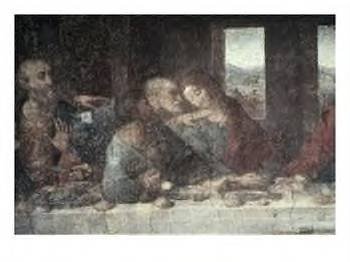
Take a look at this closer view of the painting. John referred to Himself as "the one Jesus loved" in his own gospel (see John 19:26; 20:2; 21:7, 20). John was also a younger disciple, who lived much longer and ended up writing the Revelation as an older man. It is John who was "close beside Jesus." Then notice the gospel says that Simon Peter motioned to him to find out who Jesus was talking about. In the painting, you can see Peter motioning to the young John, just as the gospel says.
The painting is not trying to reveal a secret code about Mary Magdalene. It is trying to depict the horror of the moment when Jesus was betrayed.
Dan Brown doesn't get it-- or does he, with his own form of betrayal of Christ?

Thursday, May 04, 2006

Debunking Da Vinci Code # 4

On page 234 of The Da Vinci Code, the book alleges that the discovery of the Dead Sea Scrolls and the Nag Hammadi texts are proof that more than 80 authentic gospels existed which said Jesus was merely human. Dan Brown strikes out on these claims.
First, the scriptures found in the Dead Sea Scrolls are Old Testament texts that have nothing to do with the New Testament gospels. So the number of gospels discovered in the Dead Sea Scrolls was zero. (Strike one!)
Second, the Nag Hammadi texts had 45 titles, only five of which were gospels: The Gospels of Truth, Thomas, Philip, Egyptians, and Mary. All of these writings dated from the second to third century, much later than the New Testament gospels. (Strike two!)
Third, all of these later gospels taught a heresy known as Gnosticism, which denied that Jesus came in the flesh. Rather than showing Jesus to be a mere human, the Gnostic gospels actually deny his humanity! (Strike three! Dan Brown, you're out!)

(For more information, see Darrel L. Brock, Breaking the Da Vinci Code. Nashville; Nelson Books, 2004, 61-64.)