Brother Bob;
Where can I go to find out more about what is right to eat according to the Bible? I have read Leviticus chapter 11. I have been told by others that is just for the Jewish faith and I have been told by others that I talk to that we should follow the new testament, which I have not myself looked at yet (couldn’t find where).
--Cindy Goodson
Cindy,
Thank you for giving me permission to post my reply to your question on my blog.
Leviticus 11 does give food restrictions to Jews for ritual cleanness. Some Christians feel that these dietary laws no longer apply to Christians, while others feel that these laws do apply. I agree with the first group, that these laws do not apply to Christians. But let me give you both viewpoints.
Those who feel Leviticus 11 does not apply to Christians point out that Leviticus 11:2 gives the command to Israelites, and unless you are Jewish, you are not an Israelite. Also, notice several New Testament passages. Jesus said that what goes into the mouth that makes a man unclean, but what comes out of his mouth, that is, his words. (Matthew 15:11). Jesus also said that what goes into the body does not defile, but what is in the heart (Mark 7:18-19). Taken together, these verses seem to say that Jesus did not consider the dietary laws necessary for his followers. Does that mean Jesus rejected Leviticus as inspired scripture? Not at all. The point of the Leviticus 11 commands was holiness. Leviticus 11 never says to avoid these foods for health reasons, although there can be health benefits to avoid some of them. Instead, Leviticus 11 says to avoid them in order to be holy. Why avoiding certain foods makes one holy is not explained, but that's the reason Leviticus 11 gives. Jesus was applying that principle of holiness, and showing how we can get so legalistic with such things that we miss the main point, which is a holy life by saying the right words and having a right heart. Jesus often did that, where he took an Old Testament law and applied the principle and spirit of it. He did that a lot in Matthew 5 in the Sermon on the Mount, when he said the law said not to murder but he said not to hate and call people names, and the law said not to commit adultery but he said not to lust.
Also, Acts 10:9-16 records a vision that the apostle Peter received telling him to eat the very foods listed in Leviticus 11. This vision was given to show him he should accept Gentiles (non-Jews) into the faith, because later in that chapter a delegation came and asked him to share the gospel with a Gentile. (Up until that point, all Christians were Jewish believers, but soon it was to spread to Gentiles.) Setting aside the dietary laws was a symbolic way to show Peter to accept non-Jews into the faith, but it also seems to show that Christians no longer need to seek holiness through dietary laws. The apostle Paul criticized legalists who said to abstain from certain foods, and Paul said that we should receive all foods created by God with thanksgiving (1 Timothy 4:3-4).
It is interesting to note, however, that some of the animals prohibited to eat in Leviticus 11 do transmit disease or poison. For example, pigs carry trichinosis, scavenger birds pick up diseases from the carrion they eat, and many fish without fins and scales are poisonous. (This does not explain every animal in Leviticus 11. Arabs consider camels a delicacy and there seem to be no health risks with eating camel, except the thought of it might make you sick to your stomach!). It is also interesting that Daniel chapter 1 tells the story of Daniel's decision not to eat the rich foods of Babylon, but instead to concentrate on water and vegetables, and how he was more healthy later. For this reason, there are some Christians who believe in following the dietary laws of the Old Testament.
I think all Christians would agree that the guiding principle should be 1 Corinthians 6:19-20, which reminds the Christian that his or her body is the temple of the Holy Spirit, and our bodies belong to God, so the body should be treated with holiness. This verse alone should motivate us to exercise and eat healthy foods. Unfortunately, we Baptists are bad about church pot-luck suppers that aren't healthy at all!
Tuesday, March 28, 2006


Friday, March 24, 2006
"Insane" to be a Christian?
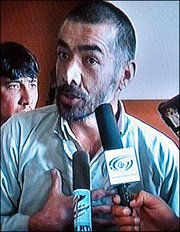
News reports today say that an Afghan Christian, who was arrested and threatened with the death penalty for the "crime" of accepting Jesus as his Savior, will probably be released from jail, thanks to pressure from Western governments.
Abdul Rahman, 41, became a Christian 16 years ago when working with Christian aid workers. Afghan officials have been discussing letting Rahman go by declaring him not guilty by reason of insanity.
The man may or may not have mental problems, but I suspect this is just a face-saving solution to let Rahman go. Yet it creates a new offense to Christians, but imlying to the Christian world that if a person converts from Islam to Christianity, he must be insane.
The United States has 16,000 soldiers in Afghanistan to help root out the old Taliban regime. Thousands of those soldiers, more than likely, are Christians. How does this make them feel?
UPDATE: A report on Sunday, March 26 says that Rahman will likely be released for lack of evidence. Again, they are searching for a reason to let him go. The evidence that he is a Christian is clear. Read this report from the Associated Press and ask yourself if there is enough evidence:
"If I must die, I will die," Rahman told the Rome daily La Repubblica, which did not interview him directly but channeled questions through a human rights worker who visited him in prison.
Rahman said he chose to become a Christian "in small steps" after leaving Afghanistan around 1990. He moved to Peshawar, Pakistan, then Germany and tried to get a visa in Belgium.
"In Peshawar, I worked for a humanitarian organization. They were Catholics," Rahman said. "I started talking to them about religion, I read the Bible, it opened my heart and my mind."
After saying he was ready to die, he told La Repubblica: "Somebody, a long time ago, did it for all of us," in a clear reference to Jesus Christ.
FURTHER UPDATE: Rahman was released and safely out of the country of Afghanistan.
NAMB takes action
Yesterday at our trustees meeting of the North American Mission Board, we adopted strong recommendations for strict executive level controls. Read the story from Baptist press here. The full report should be posted on the NAMB website later today. I'm pleased that the trustee process worked. It wasn't perfect, but it worked.
Wednesday, March 22, 2006
Pray for NAMB
As many of you know, I am a trustee with the North American Mission Board (NAMB) of the Southern Baptist Convention. Tomorrow, March 23, we will have a critical specially-called meeting of the trustees to deal with negative issues raised by the Georgia Baptist newspaper, The Christian Index, in an article entitled "North America: Hanging in the Balance." (You can read the article and NAMB's response on the Index's web page). Much of what we discuss as trustees is confidential, so I have not said anything before this, but for you who read my blog, I covet your prayers, especially at 10:00 a.m. as we begin the meeting, and throughout the day. I am very, very concerned about this meeting. Pray for God to be glorified through it all.
Sunday, March 19, 2006
Effingham fastest-growing county in south Georgia
A new census report lists Effingham County, Georgia as the 28th fastest-growing county in the United States, 7th in Georgia, and first in south Georgia (the faster-growing counties in Georgia are all in the Atlanta and Athens area).
Effingham County, of which Rincon is the largest town, grew 5.4% in one year, from July 1, 2005 and July 1, 2005. This represents 2,409 new residents in one year.
My wife, who is registrar at Effingham County High School, can vouch for the rapid growth. In four years, she has seen the high school's enrollment go from about 1200 to nearly 1500.
In this environment, our church MUST put a heavy emphasis on evangelism. To fail to emphasize evangelism where so many new people are moving would be a sin! That is why we do dramas like "Heaven's Gates and Hell's Flames," and have regular outreach programs called F.A.I.T.H. and G.R.O.W. We have been criticized for our aggressive evangelism at times, but to quote D. L. Moody, "I like the way I do evangelism more than the way you don't do evangelism."
Effingham County, of which Rincon is the largest town, grew 5.4% in one year, from July 1, 2005 and July 1, 2005. This represents 2,409 new residents in one year.
My wife, who is registrar at Effingham County High School, can vouch for the rapid growth. In four years, she has seen the high school's enrollment go from about 1200 to nearly 1500.
In this environment, our church MUST put a heavy emphasis on evangelism. To fail to emphasize evangelism where so many new people are moving would be a sin! That is why we do dramas like "Heaven's Gates and Hell's Flames," and have regular outreach programs called F.A.I.T.H. and G.R.O.W. We have been criticized for our aggressive evangelism at times, but to quote D. L. Moody, "I like the way I do evangelism more than the way you don't do evangelism."
Tuesday, March 14, 2006
Hate crime or not? A Savannah case study
Recently Savannah had its own example of what at first seemed to be a "hate crime," until, as Paul Harvey would say, we got "the rest of the story." As you read this timeline, please understand that in no way do I advocate the beating of this man. But it is also wrong to twist the truth. Here is the timeline:
Sunday, March 5, 2006: Five soldiers from nearby Fort Stewart severely beat David Bennett, 37, in the wee hours of Sunday morning outside Blaine's, a Savannah gay bar, according to police reports.
Tuesday, March 7: The Savannah Morning News reports the story of beating, and quotes gay and lesbian advocates on the need for hate-crime legislation. Senate Bill 347 is cited, which enhances penalties for defendants found to have chosen their victims based on "race, religion, gender, national origin or sexual orientation."
Wednesday, March 8: The Savannah Morning News reports, "Savannah attack cited in Senate." Chuck Bowen, the executive director of Georgia Equality, the state's largest gay advocacy organization, read from the police report about David Bennett's beating, to urge the Senate Judiciary Committee to approve the hate crime legislation. The committee approved the bill by an 8-3 vote. "The (beating) was an opportunity to send a message that bigotry is not welcomed in this state," Bowen said. Notice the word "opportunity." As we will see, this was more of an "opportunity" than a real event.
Thursday, March 9: The Savannah Morning News writes an editorial, "Equal Justice," saying that "the problem with hate-crime laws is that they undermine the concept of equal justice," because it creates "two sets of rules, one which favors certain groups over others." The editorial closes by saying that the soldiers should be prosecuted "for their violent acts, not their ugly beliefs." Amen! And now watch the story unravel:
Friday, March 10: The Savannah Morning News reports "Beating victim arrested." It seems that Mr. Bennett has been thrown in jail along with the fives guys who beat him, because there are outstanding warrants for his arrest in Florida, Virginia and South Carolina. Police say that the arrest of Bennett is because he stole a soldier's wallet, and had nothing to do with the fact that he was at a gay bar that night. Hmm. So the so-called "victim" may actually be a criminal, and while there is no excuse for the soldiers beating him, the soldiers may actually be the victims of a theft.
Saturday, March 11: The Savannah Morning News reports "Charges against soldiers dismissed." The article says that Mr. Bennett told police he did not wish to prosecute the soldiers who beat him. The article goes on to report that the soldiers met Bennett at another bar that Saturday night, called McDonough's. At the bar, they bought him drinks. Sometime during the night, Bennett allegedly stole one of the soldiers wallets. The soldiers then chased Bennett down the street to the front door of Blaine's, the gay bar. Outside Blaine's, the men beat up Bennett. During an interview with one of the intoxicated soldiers, one of them told police he beat up the "f----t." Oh, so that's what happened. A drunk soldier uses a slur against homosexuals, and when "hate speech" is used, a "hate crime" is assumed. Georgia Equality complains that the police are turning "a blind eye" toward what they still call a hate crime, saying the police are sending a message that it is "open season on lesbian, gay, bisexual and transgender Georgians." So the gay agenda marches on, ignoring the facts of this case.
Summary
It seems to me what we have here is an open season on the truth, not open season on gays. The guy was beaten by a bunch of punch-drunk angry soldiers because the guy was a thief (with outstanding warrants in three states) who stole a soldier's wallet. Should the soldiers have been drinking? No. Should they have beaten this guy? No. But does it make it a hate crime that some drunk soldiers beat up a guy who stole a wallet? Of course not!
Maybe Georgia Equality would like to sponsor an amendment to the hate-crime bill that they advocated with this erroneous story. Perhaps they would like to also make it a crime to steal from soldiers. You know, add extra penalties for stealing from America's heroes, that would be stiffer than penalties from stealing from ordinary civilians. I can hear Georgia Equality saying, "That wouldn't be right, because stealing is equally bad no matter who you steal from, soldier or civilian." Right! And beating a man is equally a crime, whether he is gay of straight, thief or honest, soldier or civilian. A crime is a crime. Classifying them as "hate crimes" shows inequality, not equality. This incident in Savannah is a prime example.
Sunday, March 5, 2006: Five soldiers from nearby Fort Stewart severely beat David Bennett, 37, in the wee hours of Sunday morning outside Blaine's, a Savannah gay bar, according to police reports.
Tuesday, March 7: The Savannah Morning News reports the story of beating, and quotes gay and lesbian advocates on the need for hate-crime legislation. Senate Bill 347 is cited, which enhances penalties for defendants found to have chosen their victims based on "race, religion, gender, national origin or sexual orientation."
Wednesday, March 8: The Savannah Morning News reports, "Savannah attack cited in Senate." Chuck Bowen, the executive director of Georgia Equality, the state's largest gay advocacy organization, read from the police report about David Bennett's beating, to urge the Senate Judiciary Committee to approve the hate crime legislation. The committee approved the bill by an 8-3 vote. "The (beating) was an opportunity to send a message that bigotry is not welcomed in this state," Bowen said. Notice the word "opportunity." As we will see, this was more of an "opportunity" than a real event.
Thursday, March 9: The Savannah Morning News writes an editorial, "Equal Justice," saying that "the problem with hate-crime laws is that they undermine the concept of equal justice," because it creates "two sets of rules, one which favors certain groups over others." The editorial closes by saying that the soldiers should be prosecuted "for their violent acts, not their ugly beliefs." Amen! And now watch the story unravel:
Friday, March 10: The Savannah Morning News reports "Beating victim arrested." It seems that Mr. Bennett has been thrown in jail along with the fives guys who beat him, because there are outstanding warrants for his arrest in Florida, Virginia and South Carolina. Police say that the arrest of Bennett is because he stole a soldier's wallet, and had nothing to do with the fact that he was at a gay bar that night. Hmm. So the so-called "victim" may actually be a criminal, and while there is no excuse for the soldiers beating him, the soldiers may actually be the victims of a theft.
Saturday, March 11: The Savannah Morning News reports "Charges against soldiers dismissed." The article says that Mr. Bennett told police he did not wish to prosecute the soldiers who beat him. The article goes on to report that the soldiers met Bennett at another bar that Saturday night, called McDonough's. At the bar, they bought him drinks. Sometime during the night, Bennett allegedly stole one of the soldiers wallets. The soldiers then chased Bennett down the street to the front door of Blaine's, the gay bar. Outside Blaine's, the men beat up Bennett. During an interview with one of the intoxicated soldiers, one of them told police he beat up the "f----t." Oh, so that's what happened. A drunk soldier uses a slur against homosexuals, and when "hate speech" is used, a "hate crime" is assumed. Georgia Equality complains that the police are turning "a blind eye" toward what they still call a hate crime, saying the police are sending a message that it is "open season on lesbian, gay, bisexual and transgender Georgians." So the gay agenda marches on, ignoring the facts of this case.
Summary
It seems to me what we have here is an open season on the truth, not open season on gays. The guy was beaten by a bunch of punch-drunk angry soldiers because the guy was a thief (with outstanding warrants in three states) who stole a soldier's wallet. Should the soldiers have been drinking? No. Should they have beaten this guy? No. But does it make it a hate crime that some drunk soldiers beat up a guy who stole a wallet? Of course not!
Maybe Georgia Equality would like to sponsor an amendment to the hate-crime bill that they advocated with this erroneous story. Perhaps they would like to also make it a crime to steal from soldiers. You know, add extra penalties for stealing from America's heroes, that would be stiffer than penalties from stealing from ordinary civilians. I can hear Georgia Equality saying, "That wouldn't be right, because stealing is equally bad no matter who you steal from, soldier or civilian." Right! And beating a man is equally a crime, whether he is gay of straight, thief or honest, soldier or civilian. A crime is a crime. Classifying them as "hate crimes" shows inequality, not equality. This incident in Savannah is a prime example.
Monday, March 06, 2006
Warning Signs of False Religion
Yesterday morning I preached on "Warning Signs of False Religion" from Deuteronomy 13, 18. Church member Chelsea Rowe shared a personal testimony of how she was a Jehovah's Witness until she was 18, and no Christian ever shared the gospel with her while she was knocking on doors.
After the sermon, people approached me with concern for friends and relatives involved in several different cults and world religions.
As I said in the sermon, Deuteronomy chapters 18 and 13 give three tests of false religion: false words, false ways, and false worship. I showed how this applies to Jehovah's Witnesses, Mormons, witchcraft, Islam and other groups. Click on the "comments" below and read the text of the entire sermon in the first comment.
After the sermon, people approached me with concern for friends and relatives involved in several different cults and world religions.
As I said in the sermon, Deuteronomy chapters 18 and 13 give three tests of false religion: false words, false ways, and false worship. I showed how this applies to Jehovah's Witnesses, Mormons, witchcraft, Islam and other groups. Click on the "comments" below and read the text of the entire sermon in the first comment.
Friday, March 03, 2006
Reflections on a mission trip
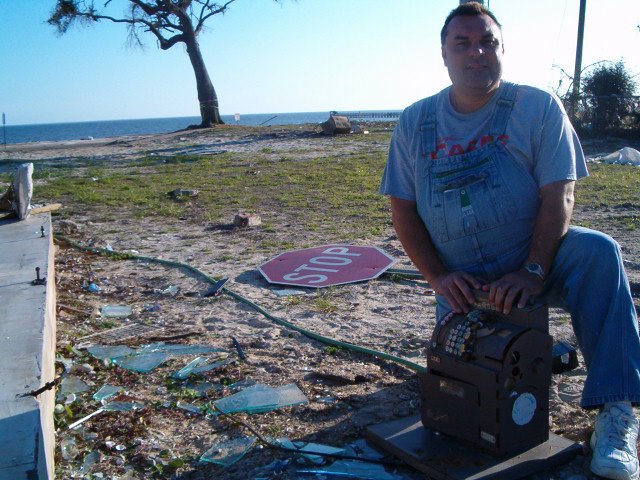
Ron Coats with a cash register he found where there once was a "Hurricane Camille Gift Shop" along the Mississippi Gulf Coast.
We got back to Georgia last night, and yesterday and today I've had time to reflect on our recent mission trip to Mississippi. I would say it was one of the best mission trips I have been on, ever. Our team cooperated together beautifully; nobody complained (they joked that after last Sunday's sermon on the Israelites "grumbling in the wilderness" there was no way they were going to complain about anything) and everybody worked hard. The people at New Evening Star Baptist Church in Gulfport were very appreciative, and they worked right alongside us. We really got to know them personally by staying in their homes and working side by side with them, and then worshiping with them. Oh, and I have to say they outdid themselves with Southern hospitality, especially the great meals they served us every night. I actually ate catfish three nights in a row!
I was also struck by how much remains to be done. While we were in Mississippi, they were marking the 6-month anniversary of Hurricane Katrina. People in the rest of the country may think it's all over and they are back to normal lives. Well, most of the trees that fell over have been cleared, but so much remains to be done. U.S. Highway 90 is an east-west highway that goes right along the beach through the four towns of Pass Christian, Long Beach, Gulfport, and Biloxi. You can ride for miles along Highway 90 and there are no buildings on the highway. Nothing for miles but slabs where once there were restaurants, beautiful homes, and now there is nothing but occasional signs and lonely traffic lights at intersections with no buildings. Even further inland, many homes still have blue FEMA tarps on their roofs, and frequently one sees neat little trailer and camper parks with row after row of trailers or campers where people are now living because they lost their homes. No, life is not back to normal on the gulf coast, and it will not be for a long, long time.
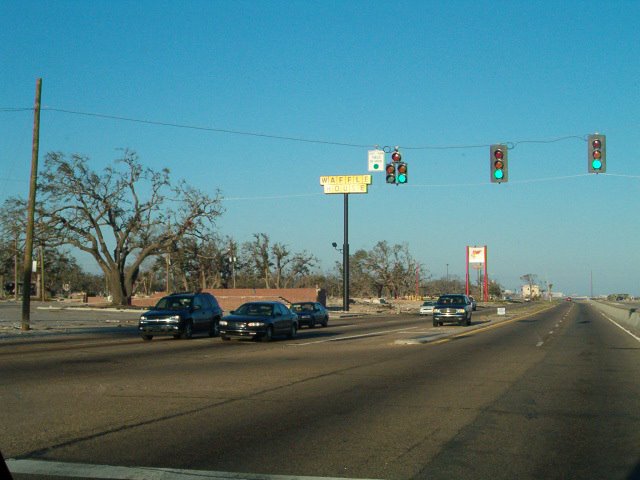
U.S. Highway 90 on the Mississippi Gulf Coast.
Thursday, March 02, 2006
Mississippi mission, second work day

On our second day of work, we finished painting the inside walls at New Evening Star Baptist Church in Gulfport, Mississippi. The ABC-TV affiliate, WLOX, came out and interviewed me and Rev. Harris. You can read their report online by clicking here.





Yesterday I took this picture which illustrates what the storm surge did. The camera is facing the Gulf of Mexico, which is about 2 blocks straight ahead. As you can see, there is nothing after this house on the right. The road is going downhill, and this house was just high enough to escape the 30 foot storm surge. There were many other houses just like this one down this street toward the gulf, and you can see that they are gone. The reason the trees are sstill standing is that they were actually under water when the winds blew in!

Wednesday, March 01, 2006
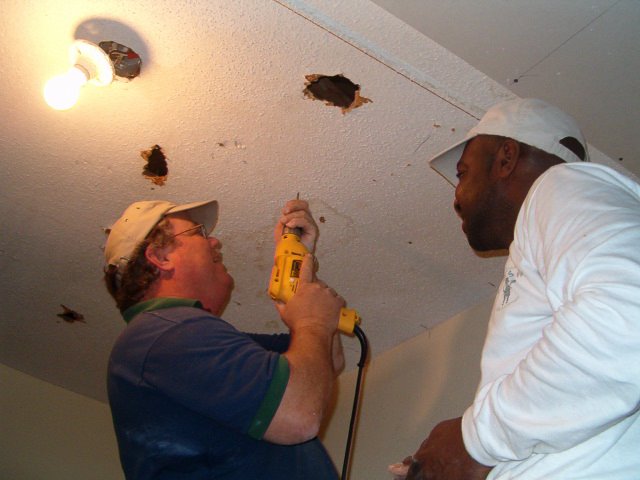
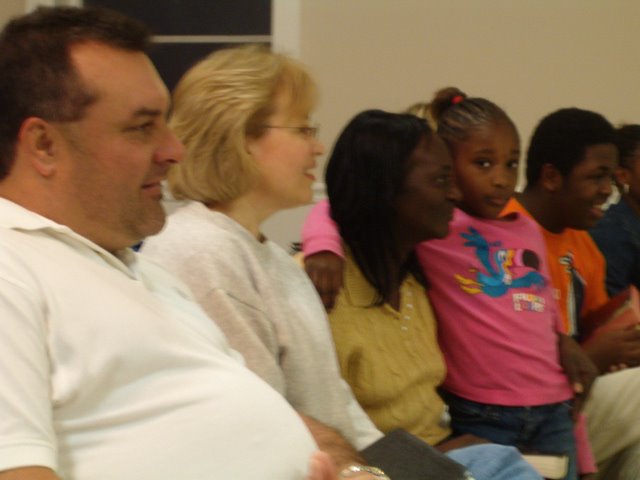
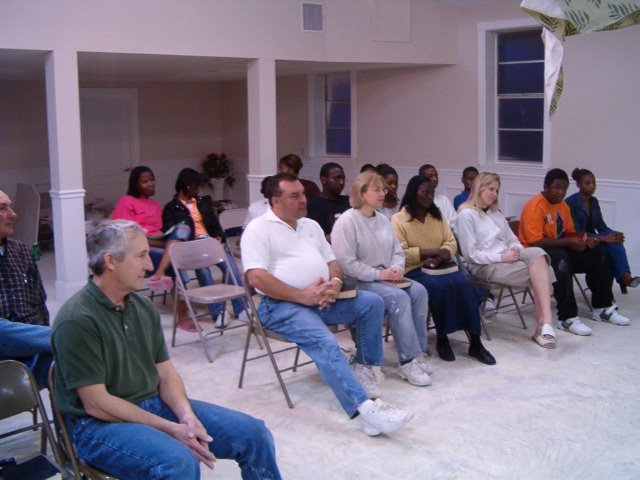
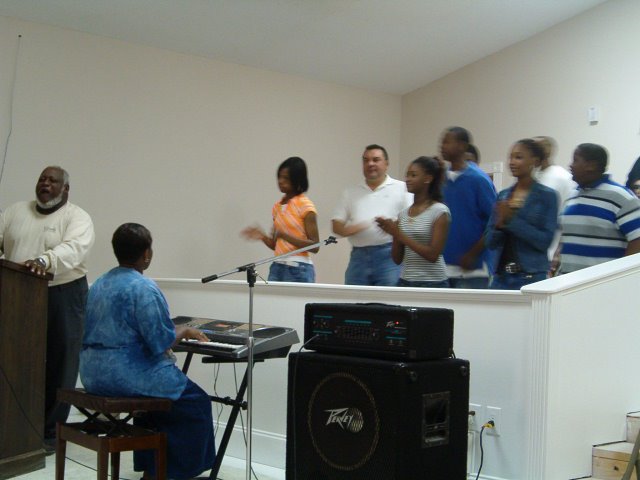
Tonight we joined with the members of New Evening Star Baptist Church for their Wednesday night service and to celebrate the completon of painting the inside of the building. They still have to spray a paint across the ceiling, which is why the ceiling fans are covered, and the only thing left after that is to put down carpet.
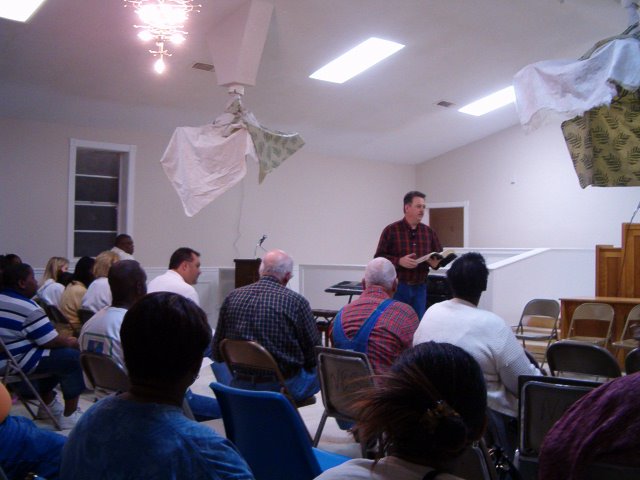
I preached on "Reasons God Allows Trouble" from 2 Corinthians 4:7- 5:1. I talked about how God allows trouble in our lives for four reasons:
- To show us that power comes from God, not from us (4:7-9)
- So that Jesus would be revealed in us (4:10-12)
- So God's grace would reach more people who would thank God (4:15)
- So we would fix our eyes on the eternal (4:16- 5:1)
Subscribe to:
Posts (Atom)